

Since 2011, The Reading Partnership has partnered with Black families and communities to support children’s literacy journeys. Through programs like the Reading Partnership for Black Parents, we’ve seen how deeply invested caregivers are in their children’s success.
In 2025, we released the Teaching Our Children to Read report in partnership with the Canadian Children’s Literacy Foundation (CCLF) and Black Health Alliance. We spoke with 167 Black caregivers across Canada to understand their experiences navigating the education system, advocating for their children, and supporting literacy at home.
Why This Matters
At The Reading Partnership, we know literacy is about more than learning to read. It’s about access. When children are confident readers, they can fully participate in school, express themselves clearly, and imagine bigger futures. But many Black children face barriers that shouldn’t exist.
Supporting literacy takes teamwork. Schools, community organizations, and families all play important roles. When all three work together, children thrive. When they don’t, families are left to figure it out alone.
What 167 Black Caregivers Told Us
Caregivers spoke about how exhausting it can be to constantly have to advocate for their kids. They know their children better than anyone, but they often have to push for assessments, support, and for someone to recognize their children’s potential.
“We heard from Black women who spent their careers leading within Canadian systems and giving back to their communities, and yet had difficulty navigating and advocating for their own children within the education system.”
– The Reading Partnership Executive Director, Camesha Cox.
The issue is not a lack of care or commitment. Families are advocating, asking questions, and doing everything they can. But many still encounter barriers that limit the support their children receive.
The Barriers Families Face
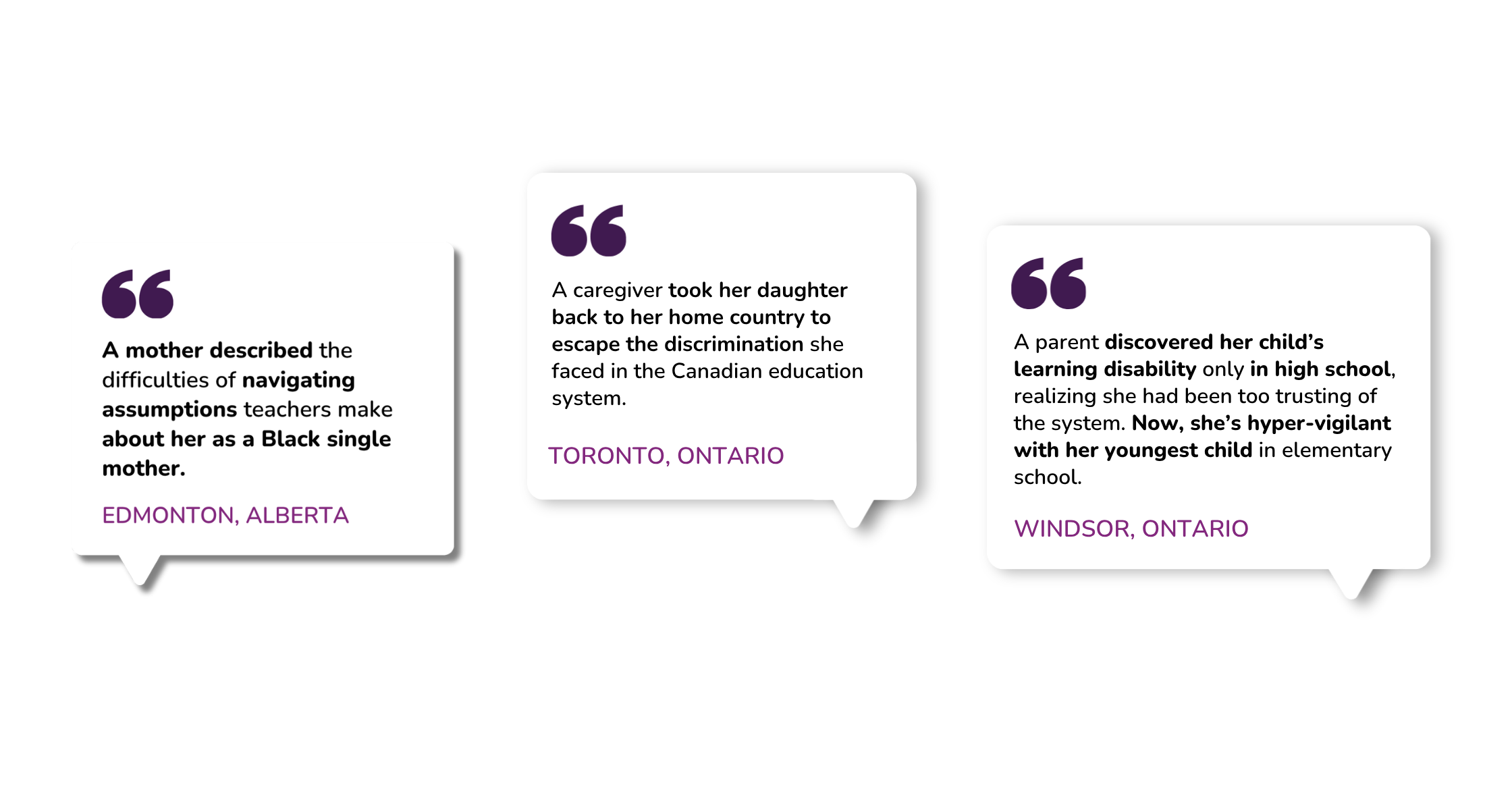
The experiences shared by families reveal several critical and recurring obstacles:
1. The Impact of Anti-Black Racism: Opportunities are often restricted by systemic stereotypes and lowered expectations, which influence the level of support provided to Black students. Further, biased disciplinary actions result in Black children spending less time in class than their classmates, leading to academic gaps and social disconnection from their peers.
2. Delayed Intervention: Many caregivers reported literacy struggles were not identified until as late as high school.
3. Isolation in System Navigation: The education system is frequently described as opaque and difficult to navigate. Without structured support, parents are often left to find resources and advocate for their children entirely on their own.
“The role of the parents.. [is] to advocate the best they can, but they can’t always do it on their own, for a variety of reasons.”
– Family member who became an advocate for their second child after the older child’s reading disability wasn’t diagnosed until middle school.
4. Lack of Representation: When curricula and programs do not reflect the identities of the students they serve, engagement suffers. Although 2024 data show just over half of children’s books feature racialized characters, specific groups remain notably underrepresented, highlighting a persistent gap in cultural relevance.
A New Path Forward
Transforming these outcomes requires a collective effort, recognizing literacy development occurs at home and in the community just as much as it does in the classroom. At present, these spheres often operate in isolation. While schools contend with resource shortages and the need for evidence-based instruction training, community organizations struggle with inconsistent funding. This leaves the heavy lifting of advocacy to families, who are often forced to navigate these systemic gaps without sufficient partnership.
As Camesha explains,
“Families bring insight, skills, and lived experience that should be respected. Community organizations need stable funding to create and sustain services that intentionally serve Black children and families. Schools need the training, tools, and capacity to use evidence-based reading instruction and address systemic racism in ways that actually make a difference day to day.”
She also emphasized the importance of industry collaboration to help drive student achievement and success, especially in Black and marginalized communities.
Children’s reading development can’t be supported in just one place. Evidence-based approaches need to extend beyond the classroom. Parents and community programs need access to these same approaches so the time families spend together makes a real impact. And it needs to happen early, before children fall behind.
From our conversations across Canada, it is clear literacy matters deeply in Black communities, and parents are doing everything they can to help their children succeed.
So What Does Success Look Like?
Success is evident in each child who is confident, engaged, and reading at or above grade level because they received early, evidence-based support. It is communities becoming a hub of support, opportunity, and empowerment for families to thrive. It is also families feeling welcomed, supported, and informed, instead of exhausted by advocacy. And most profoundly, it is children having access to programming and books that reflect who they are and help them imagine what’s possible.
Moving Forward Together
Black families have shared their vision for the future. Now, we have a vital opportunity for communities, schools, and organizations to unite in an intentional, collaborative response.
By working together, we can dismantle existing barriers and redesign systems to foster equity and excellence. Each of us plays a meaningful role in building this inclusive path forward.
Read the Teaching Our Children to Read report to discover how these family-led insights can guide our collective efforts to create lasting, positive change.